There is a line that runs through Naples like an ancient and precious scar. A street that is not merely an urban thoroughfare, but a story spanning over two thousand years. Anyone observing the historic center from the top of San Martino Hill can see it clearly: a straight line that seems to cut the city in two. It is from this evocative image that its most famous name derives: Spaccanapoli.
But Spaccanapoli does not truly divide Naples. On the contrary, it unites it. It unites eras, cultures, peoples, traditions, and destinies. It is the invisible thread that binds ancient Greek Naples to the contemporary city, the place where the past continues to breathe alongside the present.
The Origins and Evolution of Spaccanapoli
The history of Spaccanapoli has its roots in ancient Neapolis, founded by the Greeks in the 5th century B.C. The city was designed according to a strict urban layout, characterized by parallel streets and cross streets.
Spaccanapoli largely coincides with the Decumanus Inferior of the Roman era and the Plateia of the Greek era. Walking along this route, you retrace the exact same paths once traveled by merchants, philosophers, Roman soldiers, medieval nobles, and commoners of the Kingdom of Naples.
Originally, the street ran from Piazza San Domenico Maggiore to Via Duomo. Later, during the Roman era, the street was extended to include the area of what is now Piazza del Gesù Nuovo, as evidenced by the remains of Roman baths discovered beneath the cloister of the Basilica of Santa Chiara.
During the Renaissance, the street underwent enormous changes, but it was in the 16th century that Viceroy Don Pedro de Toledo decided to extend Spaccanapoli toward the hill of San Martino. He thus aligned the decumanus with a main thoroughfare of the Spanish Quarter, connecting them to the city center to facilitate travel.
Few places in the world preserve such extraordinary urban continuity. Here, history is not confined to museums: it lives in the stones, the doorways, the churches, and the voices that echo through the alleys.
What to see along Via Spaccanapoli
Spaccanapoli is not a single street, but a series of streets that change names along the way. From Via Pasquale Scura to Via Benedetto Croce, passing through Via San Biagio dei Librai, the route winds through the beating heart of the historic center.
Here, every meter holds a piece of history.
In fact, strolling along Spaccanapoli means traversing one of Europe’s greatest artistic treasures.
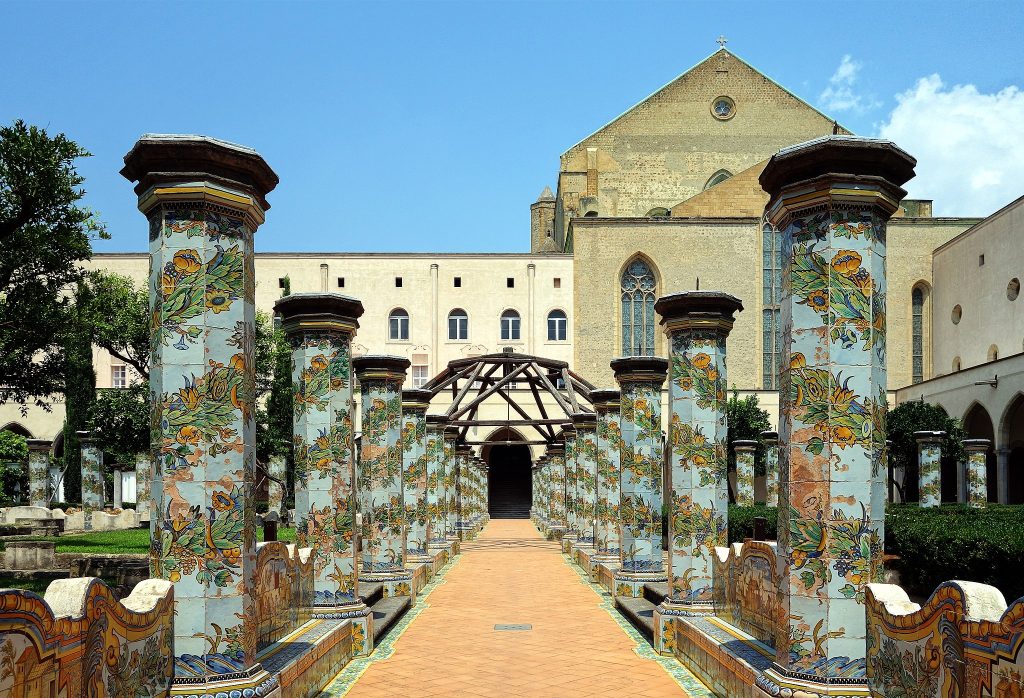
Just a short walk from one another, you’ll find extraordinary wonders, such as the Basilica of Santa Chiara, with its famous majolica cloister, a true gem of 18th-century Naples.
The majestic Church of Gesù Nuovo, famous for its distinctive rusticated façade and splendid Baroque interior.
Piazza San Domenico Maggiore, the beating heart of the street, surrounded by noble palaces and dominated by the spire. Just a short walk away is the world-famous Chapel of San Severo, home to the statue of the Veiled Christ.
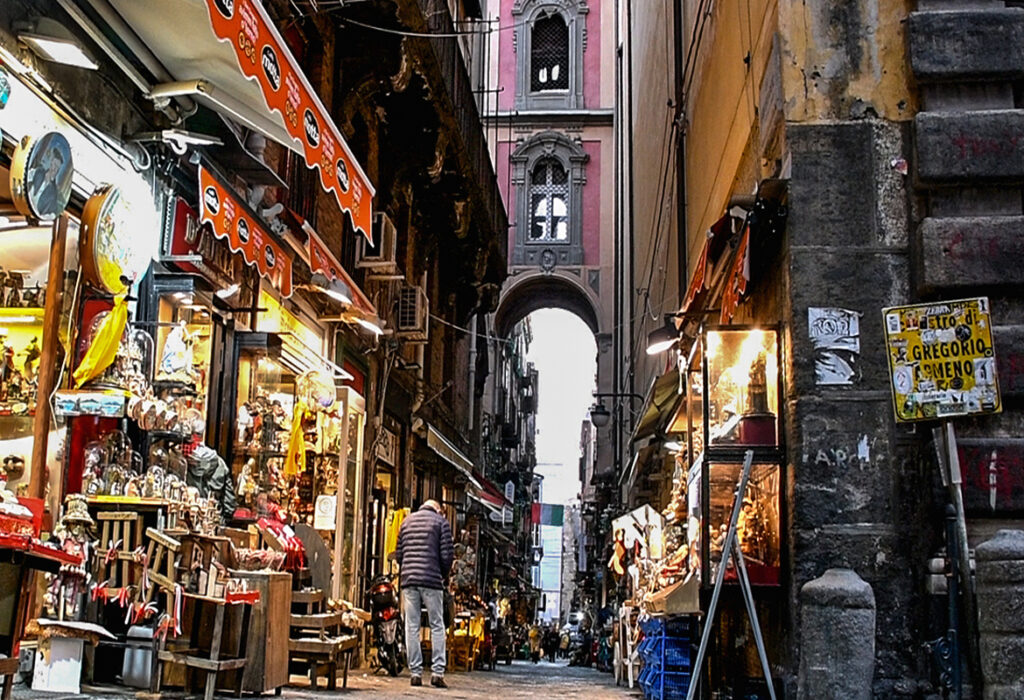
Continuing on, you’ll reach the Booksellers’ Quarter, where the memory of the old businesses that gave Via San Biagio dei Librai its name still lives on today. Here you can walk down the famous Street of the Nativity Scenes, San Gregorio Armeno.
But amid the noble palaces and historic monuments, the street is lined with pizzerias, pastry shops, and street food stalls. Where the sacred and the profane blend seamlessly, creating a unique fusion.
Perhaps no place captures the essence of Naples better than Spaccanapoli.
The charm that captivates the world
In recent decades, Spaccanapoli has become one of the most popular destinations for visitors from all over the world.
Yet its charm doesn’t stem solely from its monumental beauty.
What truly strikes you is the feeling of entering a city that has never stopped telling its own story. Every balcony with laundry hanging out to dry, every historic shop, every elderly person sitting in front of their door becomes part of a collective narrative that has been unfolding for centuries.
Spaccanapoli isn’t simply visited: it’s experienced. It’s not just a street; it’s the ancient heart of the city that continues to beat. It’s the place where the past meets the present and where every step becomes a journey through over two thousand years of history.
Those who walk through Spaccanapoli take away much more than a photograph: they take with them the memory of an authentic emotion, that of having walked through the very soul of Naples.