If you happen to be in Pompeii these days, you’ll notice a massive invasion of cartoon lobsters scattered throughout the ancient city, but what are they, and why are they there?
The numerous sculptures on display at the Pompeii excavations are part of Philip Colbert’s major exhibition, Pop Mythology, on view from July 27 through November.
An invasion of about thirty large lobster-shaped sculptures confronts one of the most important sites in world archaeology. It’s an attempt by the great British artist to create a dialogue between two eras, two languages, and two seemingly very distant ways of expressing the human imagination.
But who is Philip Colbert?
Born in Scotland and based in London, Philip Colbert is one of the most recognizable contemporary artists on the international Pop Art scene. His visual universe revolves around a recurring character, the Lobster, which has become his artistic alter ego and signature.
His works blend painting, sculpture, and art history through a hyper-pop, comic-book style that reinterprets masterpieces from art history and classical mythology.
Works explore eternal conflict, mortality, and consumerism, creating a playful bridge between antiquity and the contemporary world. Hidden within his ironic and direct style are references to art history and deeper themes, such as mortality, conflict, and humanity’s relationship with time.
The choice of the lobster is no accident. Colbert has transformed this animal into a true pop icon, but his interest also stems from its long symbolic history in art.
It is precisely this aspect that makes his encounter with Pompeii particularly significant: the artist does not bring an image completely foreign to its past to the ancient city, but rather revives a symbol that already belongs, in some way, to the figurative culture of antiquity.
Lobster and Pompeii: A Connection That Goes Way Back
The connection between Colbert and Pompeii did not begin with this exhibition. One of the key starting points is, in fact, a famous mosaic from the House of the Faun in Pompeii, now housed in the collections of the National Archaeological Museum of Naples. The mosaic in question depicts a marine scene in which a lobster, a moray eel, and an octopus are shown engaged in a sort of dramatic struggle.
It was precisely this motif that inspired Colbert to create his Pompeii Series, in which the marine world becomes a metaphor for a timeless struggle. The theme of conflict, present in the ancient mosaic, is thus reinterpreted through the artist’s contemporary language.
This reference is particularly interesting because it shows that Colbert’s Pop Art does not merely make superficial allusions to antiquity. His work begins with an archaeological image, observes it, reworks it, and transforms it into a new visual narrative.
The lobster thus becomes a bridge between the past and the present.
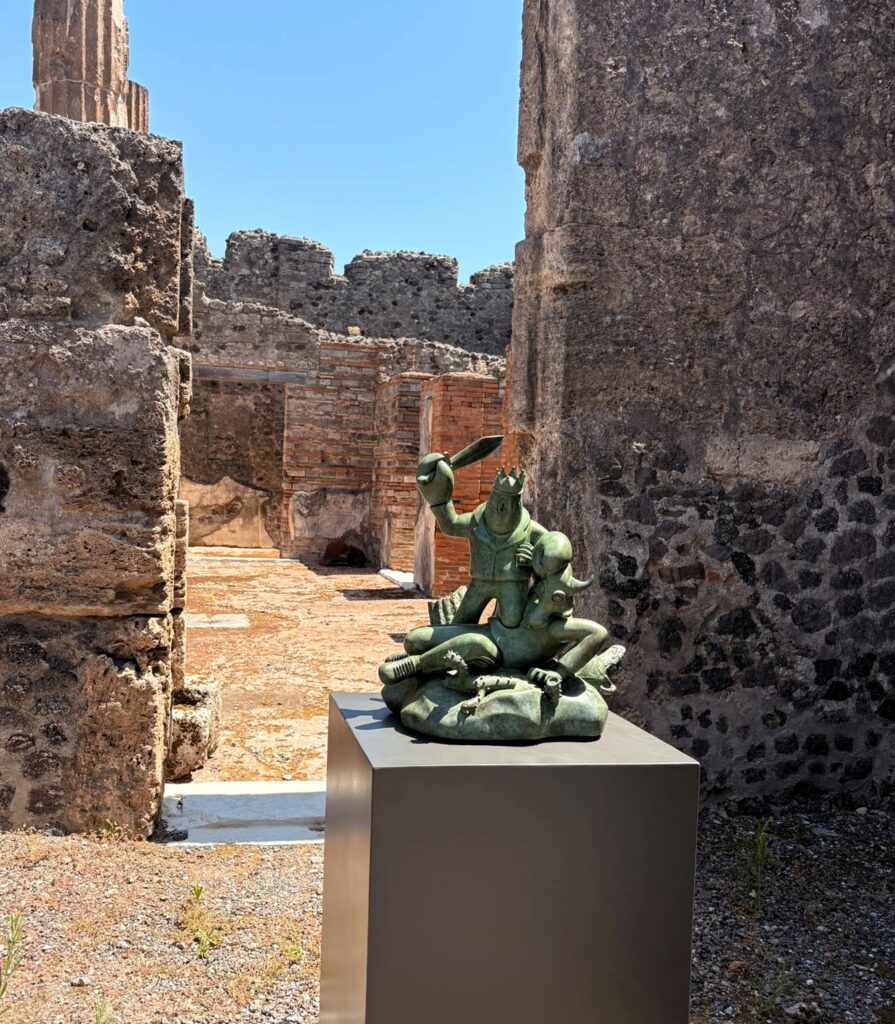
Furthermore, thanks to the immediate impact of his images, Colbert’s contemporary art can draw even those who do not normally visit museums and exhibitions to the ruins.
His monumental, ironic, and easily recognizable sculptures can serve as a gateway for children, families, and younger visitors, sparking their curiosity about the archaeological heritage.
Where to Find Colbert’s Works Outside of Pompeii
In addition to the ancient city of Pompeii, starting July 27, Colbert’s works will also be on display at sites throughout the Greater Pompeii area: Longola, Boscoreale, Oplontis, Villa San Marco, Villa Arianna, and the Royal Bourbon Gunpowder Factory.
But Pompeii is not the only archaeological site that will host Colbert’s works. The British artist has previously exhibited his sculptures in major international museums, including: the Hunan Province Museum (Hunan, China; 2022), the Times Art Museum (Chongqing; 2021). The Sejong Art Center (Seoul; 2021), and the Modern Art Museum (Shanghai; 2020).
He has also participated in a collateral event at the Venice Art Biennale (Venice; 2022). And at The Lobster Empire on Via Veneto in Rome between 2022 and 2023, as well as at the Archaeological Museum of Naples in 2024. He is certainly no unknown artist.