Perched about 350 meters above sea level, Ravello does not look up at the Amalfi Coast from below: it overlooks it with the understated, aristocratic elegance of a refuge for poets, musicians, and dreamers.
While the villages below thrive on the vibrant rhythm of the sea, Ravello stands out for its intimate and tranquil atmosphere, characterized by lush botanical gardens, Arab-Norman architecture, and panoramic views that take in the entire Gulf of Salerno from above.
From here, the Amalfi Coast reveals itself in all its extraordinary beauty: the deep blue of the gulf, the mountains descending toward the sea, the small villages clinging to the cliffs, and the colorful houses that seem to chase one another down the slopes.
Arriving in Ravello means leaving the hustle and bustle behind and embarking on a journey filled with beauty, culture, and emotion like a balcony overlooking infinity.
Origins of Ravello
Ravello’s origins date back to the 5th century, when several Roman patrician families sought refuge there during the barbarian invasions. The town’s historic turning point, however, occurred during the era of the Maritime Republic of Amalfi. During this period, Ravello became a leading commercial center, thriving on the wool trade and commerce, and was home to extremely wealthy noble families such as the Rufolos.
Over time, Ravello’s merchants established business ties throughout the Mediterranean, absorbing Arab and Byzantine artistic influences that still characterize the town’s architectural heritage today. This splendor was even celebrated by Giovanni Boccaccio in The Decameron, where he immortalized the figure of the merchant Landolfo Rufolo.
As the centuries passed and Ravello lost its economic prominence, it rediscovered itself in the 19th century as a key stop on the Grand Tour. Intellectuals, artists, and diplomats from around the world fell in love with its microclimate and unspoiled tranquility, transforming it into a cultural capital of Campania.
Windows to the Sky: Villa Rufolo and Villa Cimbrone
It’s impossible to truly appreciate the beauty of Ravello without strolling through the gardens of its two most iconic residences.
Villa Rufolo: Wagnerian Inspiration
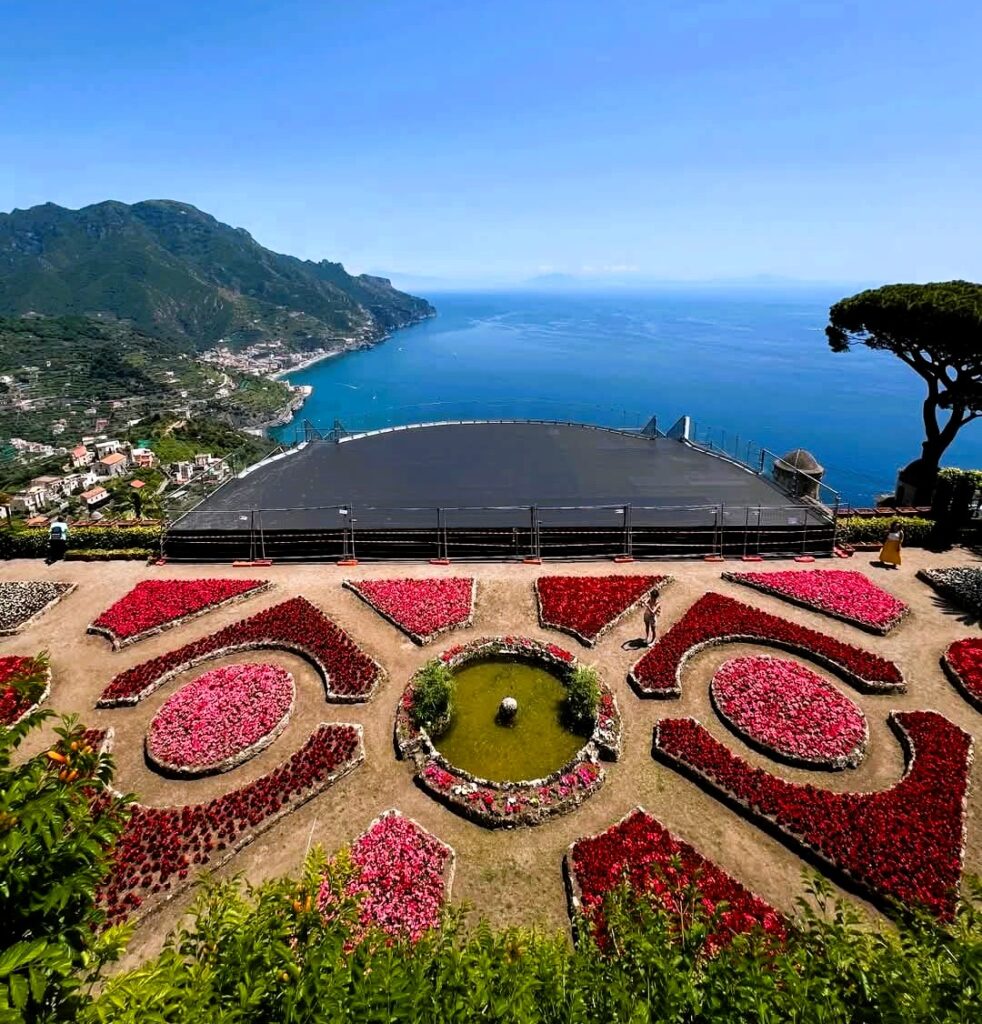
Villa Rufolo stands in the heart of the historic center, across from the Duomo. Built in the 13th century, the structure is a harmonious blend of Arab, Norman, and Byzantine art, most evident in its colonnaded inner courtyard.
Its multi-level gardens offer a picturesque view of the majolica-tiled domes of the Church of SS. Annunziata and the coastline. It was while strolling along these paths in May 1880 that the German composer Richard Wagner was struck by inspiration. He found in the villa’s gardens the embodiment of “Klingsor’s Enchanted Garden” for his opera Parsifal.
Stepping through the gates of Villa Rufolo means entering a world of architecture, history, and terraced gardens. But what catches the eye and draws you in as you stroll among the towers, courtyards, and terraces is the distinctive view of the Amalfi Coast.
Villa Cimbrone and the Terrace of Infinity
If there is one place capable of leaving even those who think they’ve seen it all speechless, it is the Terrace of Infinity at Villa Cimbrone.
Looking out from this vantage point means finding yourself face-to-face with one of Italy’s most spectacular panoramas. The sea seems to stretch endlessly, and the horizon opens up before your eyes like a gateway to infinity.
Located at the very tip of the promontory, Villa Cimbrone was renovated in the early 1900s by the English lord Ernest William Beckett. After walking along the majestic Viale dell’Immenso, you reach the famous Terrazza dell’Infinito: a natural balcony adorned with statues that seem to silently observe the landscape, while the blue of the sky and the blue of the sea meet in the distance.
A marvelous place that, throughout the 20th century, has hosted such figures as Virginia Woolf, Winston Churchill, E.M. Forster, and Greta Garbo.
Understated charm of the village
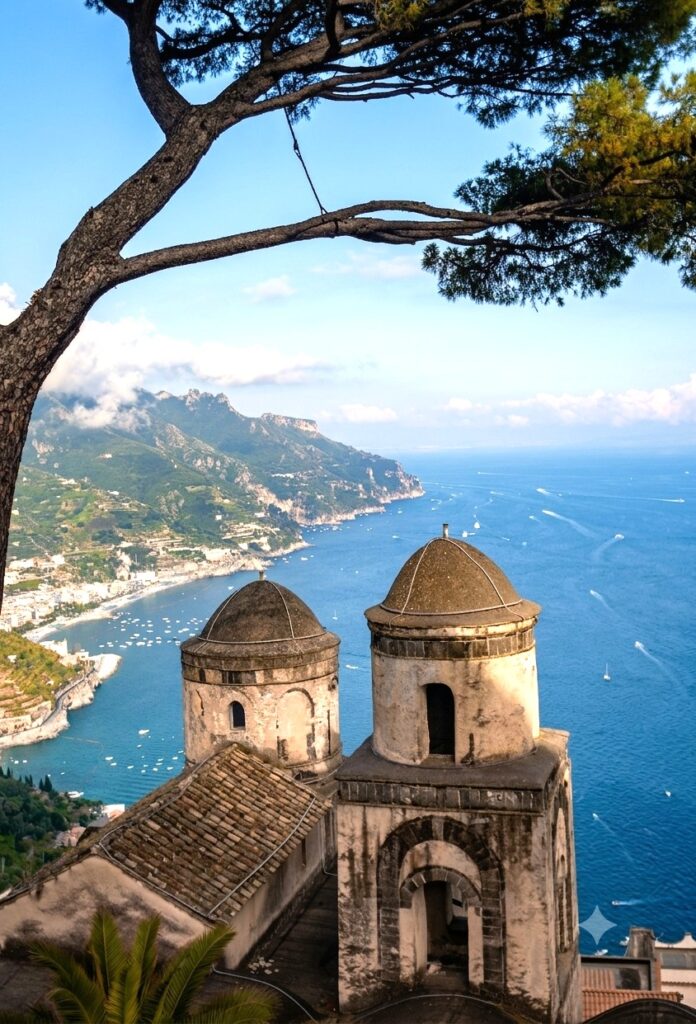
But Ravello is not just about villas and panoramic views. In the Middle Ages, thanks to its large noble population, the Ravello area boasted more than 100 public churches and private chapels; although only about thirty of them remain today.
In addition to the numerous noble palaces of Ravello’s ancient families, which have now been converted into hotels.
But the town’s true charm is best discovered by strolling through it at a leisurely pace.
The historic center is a maze of narrow streets, arches, stairways, and small squares. Every corner seems to hold a story, and every view invites you to stop and linger.
The heart of the town is Piazza Duomo, dominated by the Cathedral of Santa Maria Assunta and San Pantaleone. Here, the atmosphere is elegant and intimate, almost timeless.
Sitting for a few minutes in the square, watching the comings and goings of people, and letting yourself be enveloped by the tranquility of the place is a simple experience, but precisely for this reason, a precious one.
The Ravello Festival: Where Music Meets Nature
The deep connection to Wagner laid the foundation for the town’s musical spirit. Since 1953, Ravello has hosted the Ravello Festival (also known as the Wagner Festival), one of Italy’s oldest and most prestigious festivals of classical, symphonic, and cultural music.
Here, music seems to take on a whole new dimension.
The festival’s defining feature is its stage: a structure suspended in mid-air, built on the terraces of Villa Rufolo, that appears to float directly over the waters of the Gulf. Attending a concert at sunset, or the famous Concerto all’Alba, which welcomes the first light of dawn with symphonic notes, is a sensory experience in which the music engages in a live dialogue with the natural landscape.
When to Visit Ravello
Every season gives Ravello a different look.
Spring is perfect for immersing yourself in the colors and scents of its gardens. Summer brings bright days and the energy of the Amalfi Coast. Fall offers a more intimate atmosphere and an extraordinarily warm light, while winter lets you discover the village in an even more special kind of calm.
If possible, we recommend spending at least one full day in Ravello.
Don’t limit yourself to a quick visit. Ravello deserves your time.
Because its charm cannot be captured in a single photograph or a list of sights to check off.
It is precisely when you take the time to let the moments unfold slowly that the town reveals its most beautiful emotions.