The most frequently asked question before visiting one of the most important and visited places in the world is: what is there to see in Pompeii?
You should know that visiting Pompeii is not just a tourist experience. It is a direct encounter with the past, a silent journey through interrupted lives, everyday dreams, and a city that, despite everything, continues to speak. Walking through its streets means listening to an ancient story of almost two thousand years, suspended in time under the immobile gaze of Vesuvius.
Seeing Pompeii means discovering an incredibly lively city, rich in history, art, and unique testimonies. These come back to life thanks to the stories of those who know these places perfectly, so don’t miss the extraordinary experience of someone telling you about Pompeii and its history. Visit it with an expert tour guide.
Visiting Pompeii is a profound cultural experience, capable of moving and captivating every visitor.
The main places to see in Pompeii
Walking through the streets of Pompeii means immersing yourself in a real Roman city, with houses, shops, temples, and public spaces that are perfectly recognizable and preserved. However, the dense network of intersecting streets and the sheer size of the archaeological site, which covers 60 hectares, often makes visiting it very difficult for those who are unable to navigate maps and narrow streets.
Visiting the most beautiful and famous places often becomes complicated, so if you don’t want to waste time wandering around aimlessly, I recommend visiting with a tour guide.
But what are the most beautiful, best-preserved places that you can’t miss on your visit to Pompeii?
The Forum of Pompeii
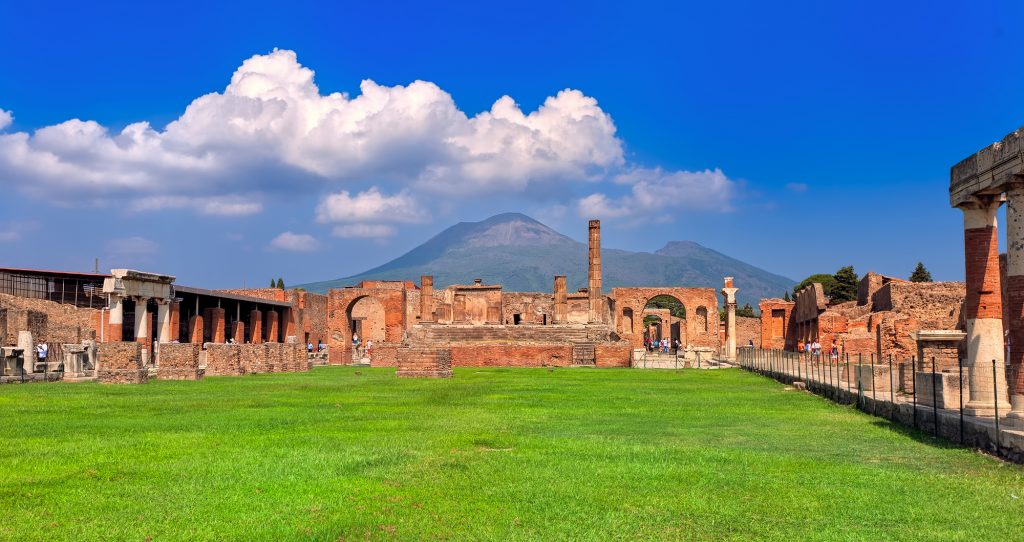
First of all, the forum, the beating heart of ancient Pompeii, the main square, which we find in all newspaper articles whenever Pompeii is mentioned. Today it is a large, quiet space, but just close your eyes to imagine the sound of voices, political speeches, and prayers addressed to the gods.
In front of it stands the Temple of Jupiter, with Vesuvius in the background. Here, you experience a powerful sensation: beauty and tragedy coexist in the same view. It is one of the most intense places to visit if you really want to understand what to see in Pompeii.
The Baths of Pompeii
The baths were a place of relaxation, recreation, and social life in Roman times. Despite the catastrophic eruption, they remain one of the places that still retain their beauty and elegance intact. Several well-structured baths have been preserved in Pompeii, such as:
- Stabian Baths: the oldest and largest
- Terme del Foro: frequented by the city’s inhabitants and perfectly preserved.
- Central Baths: still under construction at the time of the eruption
Here you can see the different rooms: calidarium, tepidarium, and frigidarium.
The Brothel
The place of perdition, the one that tells the story of erotic Pompeii, the place that narrates the desires and customs of the time without hypocrisy. Here, the erotic frescoes found on its walls do not scandalize: they explain, narrate, and show a real, human society, far from idealization.
A few steps from the forum and next to the Stabian baths, you can see this place, one of the best preserved ever found in history.
The Domus: the most famous houses in Pompeii
Visiting Pompeii means seeing one of the most fascinating aspects of the ancient city: its domus. These were the large private residences of the wealthiest citizens, decorated with extraordinary frescoes and mosaics that reveal the customs and traditions of those who lived there.
There are hundreds of them in Pompeii, but among the most beautiful ones that you cannot miss during your visit are:
- House of the Faun: one of the largest and most luxurious, famous for its mosaic of Alexander the Great
- House of the Vettii: an exceptional example of Roman painting, recently restored
- House of the Golden Cupids: probably belonged to a family related to Poppea, the second wife of Emperor Nero.
- House of Menander: reflecting the refined and cultured taste of Pompeii’s ruling class.
- The House of the Ceii: from the inner courtyard, which incredibly preserves the vivid colors of its wonderful wall fresco.
- Orchard House: located along Via dell’Abbondanza, it features fruit trees and beautiful gardens.
- Praedia by Giulia Felice: characterized by sumptuous details.
- House of Venus in a Shell, named after the painting found in the house’s internal garden
- House of the tragic poet, famous for its cave canem mosaic.
The Grand Theater and the Small Theater
And among the houses, baths, and streets, don’t miss a visit to Pompeii’s large and small theaters. These places speak of a city that loved music, poetry, and entertainment. The Large Theater could seat up to 5,000 spectators. The Odeion (Small Theater) was used for musical and poetic performances.
Amphitheater of Pompeii
The Amphitheater of Pompeii, one of the oldest in the world, built in 70 BC, tells of the passion for gladiators and the need for strong emotions. It is easy to imagine the roar of the crowd, the anticipation, the tension. Today, the wind still blows through the arena, carrying with it the echo of those voices.
But its well-preserved structure shows and tells us exactly what it was like 2000 years ago, before Pompeii was buried by the mountain that was once a friend to the Pompeians.
The casts of the victims: the soul of Pompeii
And we cannot conclude our article on what to see in Pompeii without mentioning one of the most exciting elements of its history, the famous Pompeii casts.
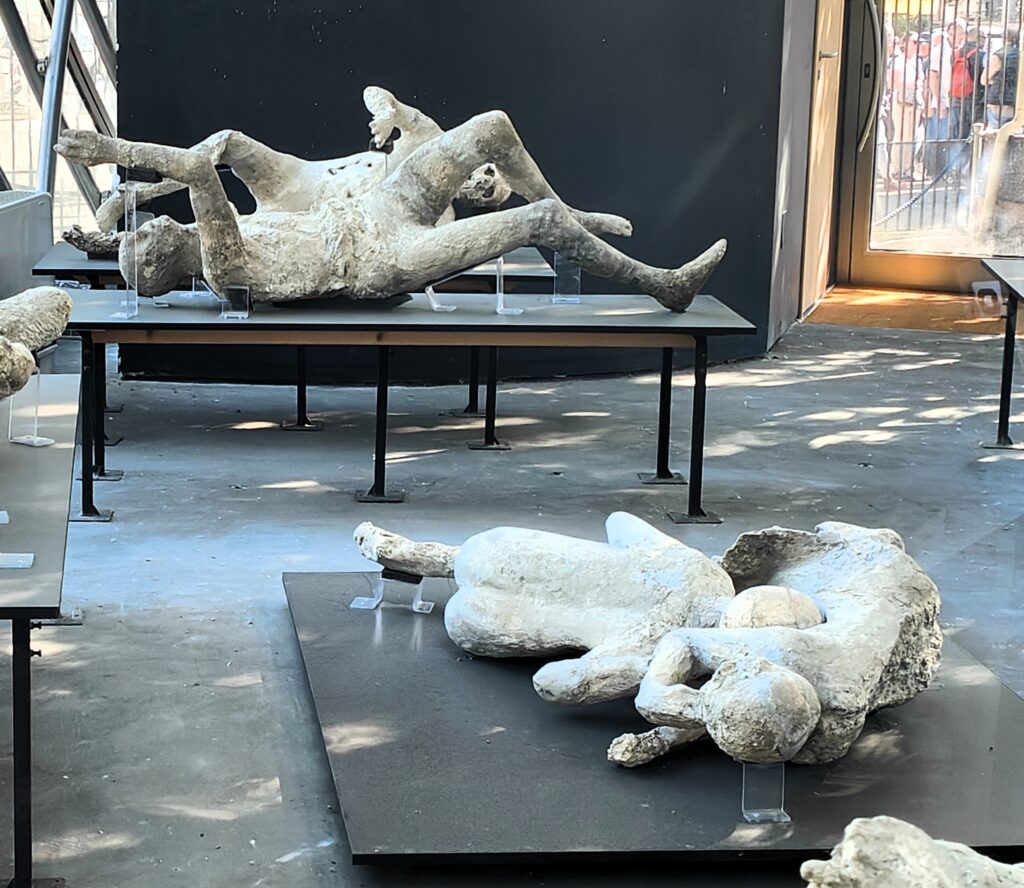
The bodies of men, women, and children trapped in plaster at the exact moment of their demise. Hands raised, bodies curled up, protective gestures. These are not artifacts. They are people.
And this is where Pompeii ceases to be history and becomes memory.
Castings made by one of the most famous archaeologists in the history of Pompeii, Giuseppe Fiorelli, who, thanks to the method already tested by Marco Bonucci, managed to bring the tragedy of Pompeii to life.
Castings that can be seen in the Macellum of Pompeii, the Stabian Baths, the Villa of the Mysteries, the entrance to the amphitheater, and the city’s antiquarium.
Altri informazioni utili
-
How to get to Pompeii
Come raggiungere gli Scavi di Pompei in auto, pullman o treno partendo da Napoli o Sorrento. Con indicazione degli orari di partenza dei mezzi e la tratta da utilizzare.
Scopri come
-
The excavations of Pompeii: Info hours, tickets, free Sundays
Tutte le informazioni sull’acquisto dei biglietti di ingresso agli Scavi archeologici, le tariffe e gli orari.
Scopri come
-
Archaeological excavations of Pompeii: all Faq
Scopri come
-
Visiting the excavations of Pompeii: route for the disabled
Tutte le informazioni per visitare gli Scavi di Pompei con disabili
Scopri come
-